

Every year when we start planning this event, I wonder whether it still feels as necessary as it did the first time. And every year, the answer is yes. This year, more than ever.
On Wednesday 25 February, around 65 charity investment professionals, trustees and advisers gathered for the fourth edition of Utilising Whole Endowments for Mission, a day of honest, practical conversation about one of the most important and increasingly discussed questions in the charity sector: how do we make sure the money we invest is working as hard for good as the money we give away?
The energy in the room was wonderful. And the quality of the conversation, honest, practical, and at times quite challenging in the best possible way, was everything we hoped for.
A room that has grown up
One of the things I most value about this event is that it brings together charities at genuinely different stages. At the start of the day, 32% of attendees told us they were just beginning to explore responsible investment, 38% had an established approach but wanted to go further, and 30% were actively pursuing a whole-endowment or mission-first approach. That diversity matters as it means the conversations are grounded in real, varied experience.
But something else was noticeable this year, and one attendee captured it well in a reflection shared after the event:
“The overall level of literacy around responsible and impact investing felt much higher than in previous years. The discussion was less about whether charities can align investments with mission, and more about how to do so in a way that is properly governed and financially sustainable.” Event attendee
We felt that too. Four years on, this conversation genuinely feels more grounded and more practical. The question is no longer ‘should we?’ it is ‘how, and how well?’
Seb Elsworth of event partner Access — The Foundation for Social Investment, who attended the event, put the fundamental question simply and well:
“Like all foundations, the investment decisions we make as we look after our treasury have an impact. The question for us all is how aligned that impact is with mission? To what extent are you seeking to reduce harm, benefit stakeholders or contribute to solutions? Or are you just trying to maximise returns, and potentially causing more harm than your grant making can mitigate?” Seb Elsworth, Access — The Foundation for Social Investment
Access’s own endowment, with 62% invested in organisations delivering social impact in 2024, including 42% directly in UK charities and social enterprises, is a compelling example of what mission-aligned stewardship can look like in practice. We are grateful to Seb for sharing that experience and for the broader conversation it sparked.
What the conversations surfaced
Across the panels, workshops and breakout discussions, a number of themes felt particularly alive.
The centrality of investment governance and policy came through strongly from the opening panel. As one attendee observed afterwards, “the investment policy is increasingly being treated as a working document, not one for the bottom drawer.” Gail Cunningham, who led the development of the Charity Investment Governance Principles, made the case compellingly, as did Charlene Cranny of Chapter Zero Alliance, who brought fresh thinking on climate and nature governance and the practical value of scenario analysis as a trustee tool. Peter Webster, EIRIS Foundation’s CEO, spoke to the importance of social issues, human rights, corporate lobbying, labour standards, as directly relevant to all charity investors, not just those with an explicit social mission.
“All investments carry risk, and all investments have an impact, not just ‘impact investments’. Some of that impact may be negative, and may be actively working against your mission.”
The reframing that every investment decision is already an impact decision, whether you choose to engage with that or not, was one of the most important threads running through the day, particularly in the introductory breakout session. It shifts the question from ‘should we think about impact?’ to ‘how deliberately do we want to engage with the impact we are already having?’
The breakout sessions also surfaced something deceptively simple but genuinely powerful: the difference one internal champion can make. Someone who keeps the conversation alive, maintains momentum between trustee meetings, and stops responsible investment from slipping down the priority list when capacity is stretched. If you are that person in your organisation, the room had a clear message for you: you matter more than you know.
The BD Giving workshop on inclusive investment was one of the most thought-provoking sessions of the day. It invited us to step back from the technical and ask some more fundamental questions: who holds influence in investment decision-making? Whose voices shape the process? What would it genuinely mean to share that power? It was a timely reminder that how decisions are made matters as much as what decisions are made and that inclusive practice is not an add-on to responsible investment, but part of what responsible investment should mean.
The afternoon panel on collaboration and partnership, featuring Charlie Crossley from Friends Provident Foundation on the Endowments Investing Challenge, Amy Gutcher from Sumerian on the Beyond Barriers pilot, and Danielle Vrublevskis from ShareAction on collective stewardship, reinforced a point that ran through the whole day: charities are more powerful when they work together. Collaboration does not require perfectly aligned missions. It requires shared values, genuine trust, and a realistic view of the time and energy it takes. When those things are in place, the results can be significant.
The day closed with a fireside conversation with Erinch Sahan of the Joseph Rowntree Foundation, who shared JRF’s journey toward a fully mission-aligned endowment with characteristic honesty and generosity. One piece of his advice stayed with the room: don’t start with the limitations of finance. Start by identifying the economic transformations you want to drive, and then work out how to pursue them rather than letting the current levers of the financial system set the ceiling for your ambition. It requires, as he put it, a certain tolerance for discomfort. But it also requires solidarity – progressive investors helping to legitimise the change that the wider system will eventually need to follow.
A frank word on investment managers
We want to reflect honestly something that came up repeatedly across the day. Many organisations expressed real frustration with their current investment managers with the quality of communication, with a sense that traditional asset management models are not well-suited to values-based investment, and with the difficulty of obtaining meaningful data and genuine engagement on the issues that matter most to them.
The sector deserves better. And charity investors, collectively, have more power to demand it than many realise. Helping to build and amplify that collective voice is a core part of what EIRIS Foundation wants to support.
What comes next
At the end of the day, we asked attendees what kind of support would be most useful over the coming months. The answers were clear: practical workshops on specific topics came top, closely followed by peer-to-peer facilitated sessions. The most-wanted workshop themes were taking a whole-endowment approach (where to begin), getting trustees on board, and impact measurement.
A striking 79% said they would be interested in a structured peer network, to offer support to others, seek it, or both. That is a powerful signal, and one we take seriously. It speaks to something Seb Elsworth also pointed to: the Impact Investing Institute’s new research, supported by Access, which explores where further support is needed for foundations looking to align assets with mission. There is no shortage of inspiration. The question, as Seb put it, is the desire to act.
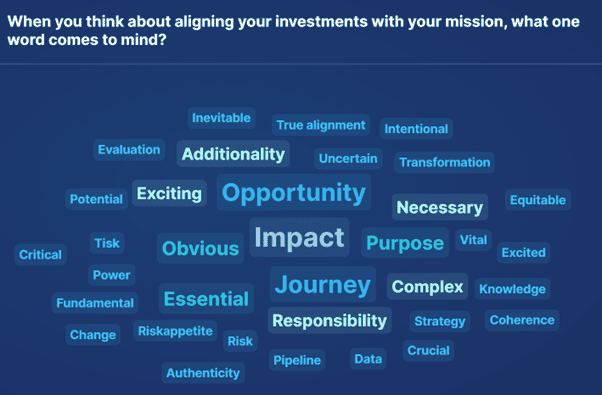
The closing word cloud from the day said it better than we could: ‘collaboration’, ‘mission first’, ‘be braver’, ‘enough talking, more doing’.
We couldn’t agree more. Watch this space.
—
EIRIS Foundation is a research, advice and advocacy charity supporting responsible and ethical investment for over 40 years. Our free resource hub for charity investors is at www.charitysri.org. To find out more or get involved in future activities, please get in touch at [email protected].
Useful resources from the day: Charity Investment Governance Principles | Chapter Zero Alliance | ShareAction | JRF whole-endowment approach | Friends Provident Foundation Endowments Investing Challenge | Access Impact Report | Impact Investing Institute research